
It usually starts small. A question about homework, a request to stay out later on a Friday, a phone that buzzes at dinner. Thirty seconds later you are saying things you swore you would never say, and your teenager has gone silent behind a closed bedroom door. In a Manhattan apartment, that door is about twelve feet away, and everyone can still hear everything.
If this sounds like your home, you are not raising a difficult child and you are not a failing parent. You are most likely caught in a pattern, and patterns can be changed. This article explains the pattern most parent–teen conflict follows, a skills approach from adolescent DBT called walking the middle path, and what working on it together looks like with Dr. Audrey Kteily, a family systems therapist who sees New York families online.
Why does every conversation with my teen turn into a fight?
Family systems therapy starts from a simple idea: a family behaves like a system, so each person’s reaction keeps the other person’s reaction going. A parent who worries tightens the rules. The teen pushes back harder. The parent reads the pushback as proof the worry was right and tightens again. Neither person is the cause. The loop is.
That is why advice aimed at only one person so often fails. A teen can learn coping skills in individual therapy and come home to the same loop. A parent can read every parenting book and still get pulled back in at 11 p.m. on a school night. Change sticks when both people learn to notice the loop and step out of it, ideally in the same room, even if that room is a video call.
Adolescence also makes the loop more likely. Teenagers are wired to push for independence, and parents are wired to protect. Both drives are healthy. The trouble starts when each side answers the other by moving to an extreme.
What is “walking the middle path”?
Walking the middle path is a set of skills from dialectical behavior therapy (DBT), adapted for teenagers and their families by psychologists Jill Rathus and Alec Miller. Standard DBT teaches four skill areas: mindfulness, distress tolerance, emotion regulation and interpersonal effectiveness. Rathus and Miller added a fifth module for adolescents, designed to be learned by teens and parents together.
The module rests on one observation from their work with families: when parents and teens are stressed, they tend to swing between opposite extremes, and each swing provokes the next. They named three of these swings “dialectical dilemmas.” The skills that go with them are validation (understanding the other person’s view without having to agree), behavior change tools (encouraging what you want to see more of, instead of only punishing what you don’t), and thinking dialectically (two things can be true at the same time).
“Dialectical” sounds academic, but the core of it fits on a sticky note: you can accept your teen as they are and still ask for change. Most families in conflict believe they have to choose one.
What do the three dilemmas look like in a Manhattan family?
Each dilemma has two ends. Most families have spent time at both, often in the same week. Here is how they tend to show up for families in New York City, and what the middle sounds like.
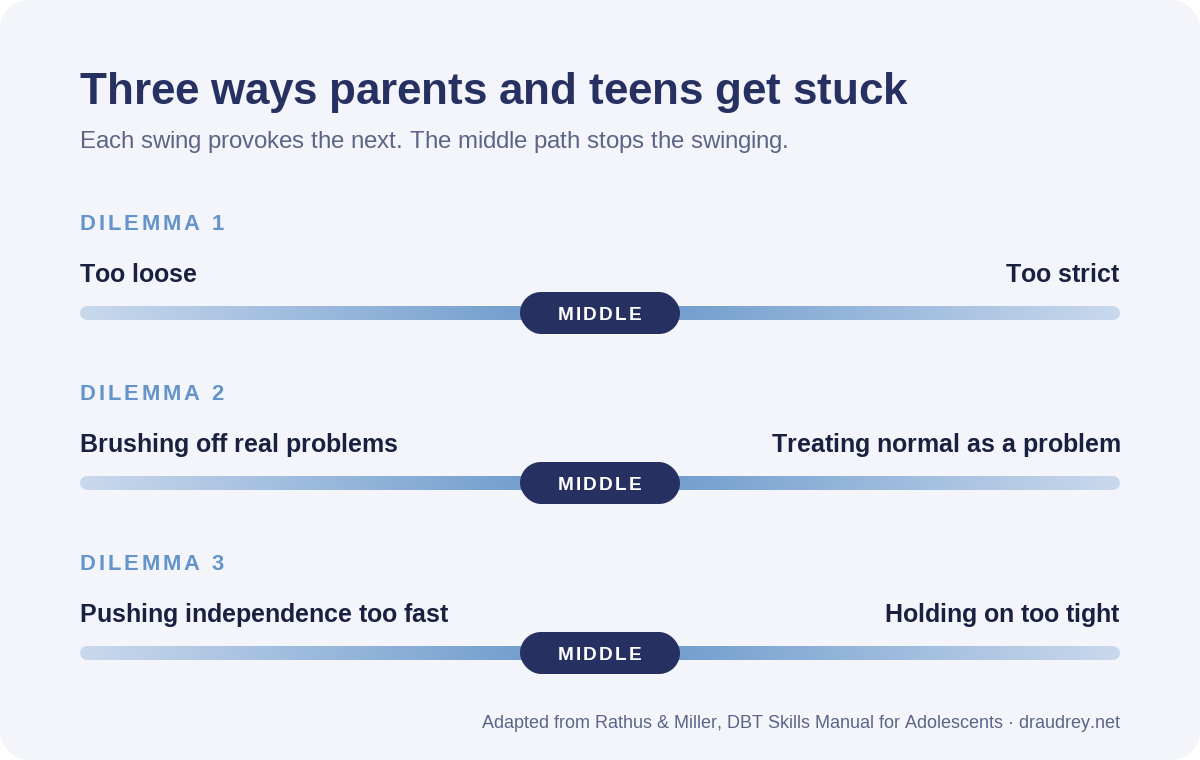
1. Too loose or too strict
Picture location sharing. After a scare, one parent turns on tracking and checks it every twenty minutes. The teen turns it off. The parent takes the phone. A week later, exhausted by the fighting, the parent stops asking where their teen is at all. That is a swing from strict to loose and back again, and the teen learns that rules depend on the parent’s mood.
The middle sounds like: “I want you to have privacy, and I need to know you are safe. Let’s agree on when location stays on, like late nights and new places, and when it doesn’t.” Then both of you keep the agreement for a few weeks before revisiting it.
2. Treating normal as a problem, or brushing off a real problem
In New York City, school admissions can feel high-stakes for eighth graders choosing high schools and for older teens applying to college. When a decision arrives that isn’t the one they hoped for, some teens go quiet for a while. A parent at one end panics that every closed door means depression. A parent at the other end says “everyone gets disappointed, you’ll be fine” and moves on.
Either response can miss the mark. Pulling back after a letdown is normal, and treating it as a crisis teaches a teen to hide feelings. But staying withdrawn for weeks, losing interest in friends, sleeping much more or less, or talking about being a burden is not ordinary disappointment. In 2023, 35% of New York City public high school students said they had felt sad or hopeless for more than two weeks in the past year, according to the NYC Health Department’s 2023 youth survey data. It is common, and it deserves attention.
The middle sounds like: “It makes sense you are disappointed. I’m going to check in with you this week, and if it still feels this heavy, let’s talk to someone together.”
3. Pushing independence too fast, or holding on too tight
Many New York City teens get around on their own by subway, and families draw that line very differently. One 13-year-old rides to school alone while a classmate’s parents won’t allow it until 16. Families swing here too: “You’re old enough, figure it out” one month, then a full lockdown after one late return.
The middle sounds like: independence in steps the teen can earn and the parent can live with. Routes you have done together first, a check-in text at transfers, then fewer check-ins as trust builds. The teen gets a clear path forward, and the parent gets a way to say yes.
What does validation sound like, and why isn’t it agreeing?
In a 2015 study by the module’s developers, 50 participants in an adolescent DBT program rated validation the most helpful part of skills training. That study measured how acceptable and useful families found the skills; how well the module works on its own is still being studied. Validation is also the most misunderstood skill. Validating your teen does not mean saying yes. It means showing that their reaction makes sense given how they see things, before you talk about what happens next.
- Instead of “You’re overreacting,” try “I can see how unfair that felt.”
- Instead of “That’s not a big deal,” try “Of course you’re upset. You worked hard for that.”
- Instead of “We’re not discussing this,” try “I hear that you want more freedom. The answer tonight is still no, and I want to talk about what would change it.”
Validation works in both directions. Teens learn to say “I get that you were scared when I didn’t answer” before arguing their side. When both people feel understood, the volume drops, and problem-solving becomes possible.
How does Dr. Audrey work with parents and teens?
Dr. Audrey Kteily holds a PhD in Family Studies from Texas Woman’s University and has more than 20 years of clinical experience. Her doctoral specialty is family systems, which shapes everything she does with teens: she looks at the pattern between people, not only at the person who was brought to therapy. That is why her teen and family counseling involves parents as part of the work rather than keeping them in the waiting room.
She is also a Certified Family Life Educator (CFLE) through the National Council on Family Relations, a credential centered on teaching families practical skills, which suits parents who want concrete tools and not only a place to vent. And she is C-DBT certified in dialectical behavior therapy, the approach the middle path skills come from. Together, those credentials combine family systems work, parent education and DBT skills.
Teens aged 12 to 18 can work with her, and she also sees young adults, parents and whole families.
Can our whole family join online, even if we’re not all in Manhattan?
Yes, within the states where she is licensed. Dr. Audrey is a Licensed Mental Health Counselor (LMHC) in New York, a Licensed Professional Counselor (LPC) in New Jersey and a Licensed Professional Counselor-Supervisor (LPC-S) in Texas. Each person must be physically located in one of those three states at the time of the session. So a parent in Manhattan, a co-parent in Bergen County and an older sibling in Dallas can all join the same secure video session from where they are. Not every therapist holds licenses in more than one state, which can leave a separated family without a way to meet together.
All sessions are 100% online by secure, HIPAA-compliant video that opens in a browser. There is no office to get to, which matters when a teen’s schedule runs from school to practice to tutoring. New York families schedule in Eastern Time. You can read more about online therapy for New York residents, including how licensing works.
Getting privacy for an online session in a small apartment
Privacy is the most common worry Manhattan families raise about online therapy, and it is solvable.
- Give your teen headphones with a built-in microphone. If others can only hear half the conversation, your teen will speak more freely.
- Pick a room with a door, any door. A bedroom, a bathroom with the fan on, a walk-in closet or a parked car all work.
- Schedule around the household. A time when siblings are at an activity, or a parent takes them for a walk, helps more than you might expect.
- Use separate devices for joint sessions if parent and teen are in different rooms. It helps each person feel like a participant rather than a spectator.
When is it more than ordinary teen conflict?
Arguments, eye-rolling and closed doors are a normal part of adolescence. Reach out for professional support when conflict is constant rather than occasional, when your teen’s mood, sleep, eating or grades change for more than a couple of weeks, when they pull away from friends, or when either of you feels unsafe. The National Institute of Mental Health has a helpful overview of warning signs in children and teens.
If your teen talks about hurting themselves, wanting to die or being a burden, take it seriously right away. Call or text 988 (Suicide & Crisis Lifeline) or call 911. Dr. Audrey’s practice is not a crisis service.
How do we get started?
You don’t need your teen’s enthusiasm to make the first call. Many parents start alone, and that often helps. Send a request through the secure appointment form, or text or call (917) 905-3183. Texting is usually the easiest; please keep health details out of texts. Dr. Audrey replies within one business day. She is an out-of-network provider and can give you a superbill to submit for possible out-of-network reimbursement, so it is worth checking your plan’s out-of-network mental health benefits first.
The middle path is not about splitting the difference or keeping the peace at any cost. It is about getting off the seesaw, so your teen can grow up and you can stay close while they do.
Sources
- NYC Department of Health and Mental Hygiene. Mental Health and Substance Use Behaviors Among New York City Public High School Students, 2023. Epi Data Brief No. 151, April 2026.
- National Institute of Mental Health. Child and Adolescent Mental Health.
- Rathus, J. H., & Miller, A. L. DBT Skills Manual for Adolescents. Guilford Press, 2015.
- Rathus, J., Campbell, B., Miller, A., & Smith, H. Treatment acceptability study of Walking the Middle Path, a new DBT skills module for adolescents and their families. American Journal of Psychotherapy, 2015, 69(2), 163–178. doi:10.1176/appi.psychotherapy.2015.69.2.163