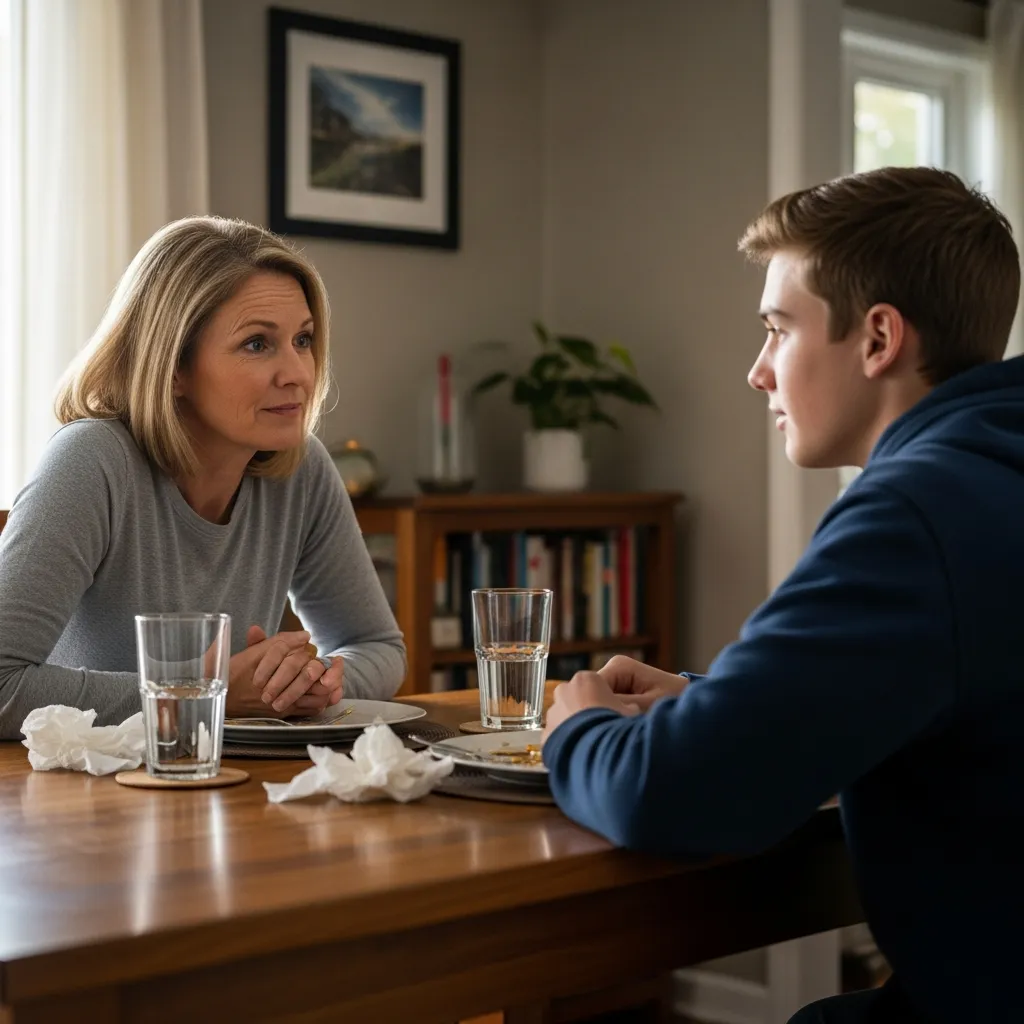
By day four, the laundry bag is still by the front door, unopened. The bedroom door stays shut until well into the afternoon. At dinner your student answers in single words, snaps at a sibling and goes back upstairs. Ask how finals went and you get “fine.”
A college student who comes home for winter break and doesn’t seem okay is a common December worry. Sometimes it is plain exhaustion; sometimes it is the first sign of something that built up at school. Here is how to tell the difference, raise it without a fight, and get help over break in Texas, New Jersey or New York.
Is it normal for a college student to crash when they get home for break?
Yes, for the first several days. After finals, home may be the first place in months where your student can sleep without an alarm or a roommate. Long sleep and low energy in week one are usually the body catching up.
Decompression tends to fade: by the second week, most students start seeing friends, eating normally and talking more. A pattern that holds steady or gets worse past a week or two is different. Watch for:
- sleeping much more or much less than usual, every day, with no sign of easing
- losing interest in friends, hobbies or people they were excited to see
- flat or hopeless talk, such as “what’s the point”
- being vague or panicked about grades, or avoiding any mention of school
- drinking or using substances more than they used to
The National Institute of Mental Health describes depression as an illness that affects how a person feels, thinks and handles daily activities such as sleeping, eating and working. One rough week doesn’t mean depression. A month that looks the same every day might.
It also helps to keep the bigger picture in view. The Healthy Minds Study, a survey of more than 84,000 U.S. college students at 135 colleges and universities in 2024–2025, found that moderate-to-severe depressive symptoms fell from 44% of students surveyed in 2022 to 37% in 2025. Moderate-to-severe anxiety fell from 37% to 32%, and serious thoughts of suicide in the past year fell from 15% to 11%. So things are improving, but more than a third still screened positive for depression: your concern is reasonable, and not a reason to panic.
Why does the whole house feel tense the first week back?
Because your student changed and the house didn’t. For months they decided when to sleep, what to eat and where to be at midnight. Then they walked back into the old rules and the old family roles.
Family systems therapy sees a family as a set of connected roles: when one person changes, everyone feels the pull to change too, or to pull that person back. A few patterns show up often in week one:
- Old rules meet new habits. A curfew that made sense at 17 feels insulting at 19, and a parent who waits up until 1 a.m. feels dismissed.
- Old roles snap back. The “responsible one” is expected to babysit again. The “funny one” is expected to lighten the mood, even when they feel awful.
- Siblings adjusted to the empty room. A younger sibling may have claimed the space, the car or the attention.
So the early fights are about dishes, the car or the thermostat, but really about who your student is now and how much say they get. Renegotiate two or three things out loud early in the break: when you need a text if they will be out late, which chores are theirs, and how much family time you hope for. This is the kind of work that family systems counseling is built around.
How do I bring it up without starting a fight?
Talk side by side, describe what you have seen, ask one open question, then stop talking. Students shut down when a talk feels like a meeting they didn’t agree to.
- Choose a side-by-side moment. A drive or a dog walk. Less eye contact, less pressure.
- Lead with what you noticed, not a verdict. “You’ve been sleeping a lot” is an observation. “You’re depressed” is a diagnosis, and it invites an argument.
- Ask one open question. Then wait. Silence is fine.
- End before it turns into a lecture. “I’m not going anywhere. We can talk more whenever you want” keeps the door open.
A few general examples of openers that tend to land better than “What’s wrong with you?”:
- “You seem really tired since you got home. How was the end of the semester, honestly?”
- “I noticed you haven’t seen anyone from high school yet. Is that on purpose?”
- “I’m not asking about grades. I’m asking how you’re doing.”
If the first try goes nowhere, you have still shown the topic is safe. Many students come back to it a day or two later.
What if my student says they don’t want to go back?
Treat it as information, not a decision. “I don’t think I’m going back” can mean a bad roommate situation, a failed class, homesickness, a breakup, or depression that makes everything feel impossible.
First find out which one it is. Ask what the hardest part of the semester was, and listen for the specific thing instead of arguing with the conclusion. Keep decisions out of the first week; choices made while exhausted rarely hold up.
Later in the break, a “pause and plan” conversation can cover what would need to change for next semester to feel possible, what the school offers (advising, a lighter load, a leave of absence) and its deadlines, and what support your student wants either way. The goal is a choice made with clear information, not drifting back out of guilt or quietly not returning.
My student is 18. What am I allowed to know?
Less than you might expect. Under the Family Educational Rights and Privacy Act, the rights over a student’s education records move from the parents to the student when the student turns 18 or enters a college or university at any age, as the U.S. Department of Education explains in its FERPA overview. That is why many colleges won’t send you grades without your student’s consent, even if you pay the tuition.
Therapy works the same way in spirit. An adult client owns their own care: they choose whether to start, what to talk about and who else is told. The practice’s own information sheet on what changes when a client turns 18 walks through that shift.
Parents still have options. You can ask your student directly to share the big picture. An adult student can sign a release that lets a school office or a therapist share specific information with you; that is their choice. You can join a family session if your student wants one, or look into parent counseling for yourself.
Can my college student start therapy online over winter break?
Yes, if they are home in Texas, New Jersey or New York during the sessions. Counselors are licensed by state, and the rule follows the client’s physical location during the session. What matters is where your student is sitting, not where the school is. Dr. Audrey Kteily is licensed in Texas (LPC-S), New Jersey (LPC) and New York (LMHC), so a student home in Bergen County, Manhattan or Coppell over break can meet with her by secure video; the page on online therapy for New Jersey residents explains how that works in one of those states.
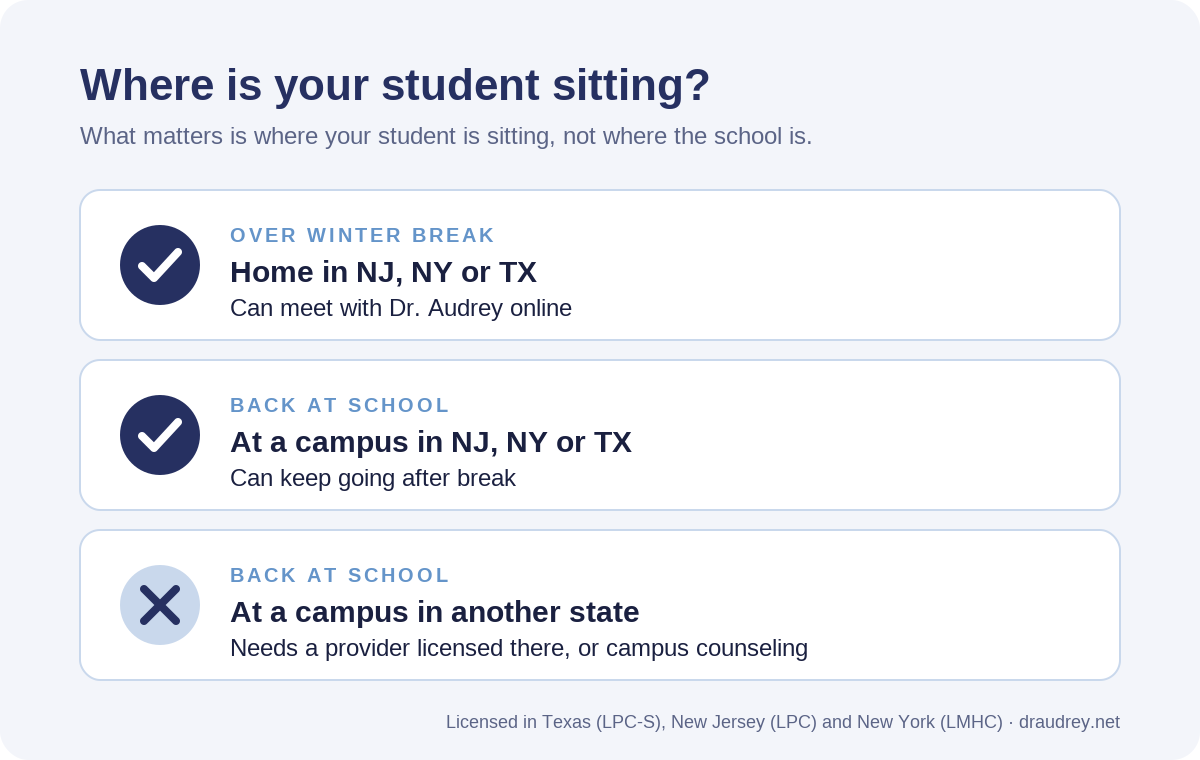
In January, a student whose school is in Texas, New Jersey or New York can keep going online from campus. A student at school in another state can’t, even on the same video link; the next step is campus counseling or a provider licensed there, ideally lined up before break ends.
An interstate agreement called the Counseling Compact has started issuing “privileges to practice” across state lines, but only in a handful of states. As of November 18, 2026, the Counseling Compact Commission lists 11 live states: Arizona, Arkansas, Georgia, Indiana, Louisiana, Minnesota, Missouri, Ohio, Oklahoma, Tennessee and Wyoming. Texas, New Jersey and New York are not among them, so don’t assume any therapist can follow a student back to school in another state.
Sessions run in a web browser with no app to download, on Central Time for Texas and Eastern Time for New Jersey and New York. For privacy at home, headphones, a closed door (or a parked car) and a parent out of earshot help a student talk honestly.
What can a family realistically do in one winter break?
Winter break usually runs three to five weeks: enough to notice, talk and get started, not to fix everything. A typical rhythm:
| When | Focus | What it can look like |
|---|---|---|
| Week 1 | Decompress and notice | Let your student rest. Keep demands light. Quietly note whether sleep, mood and appetite start to recover. |
| Week 2 | Have the conversation | One calm, specific talk. Agree on a few house expectations. Ask whether they would want to talk to someone. |
| Weeks 2–4 | Start sessions and plan | If your student agrees, begin online sessions while home. Decide together whether to continue (campus in TX, NJ or NY), hand off to campus counseling, or find a provider licensed where the school is. |
| Before leaving | Set up support at school | Make sure your student has the next appointment or contact in place before the flight or drive back. |
How is this different from the campus counseling center?
Campus centers are usually free or low cost for enrolled students and know the campus well, so they are often the right choice during the semester. The difference is scope: Dr. Audrey can work with the whole family. She holds a PhD in Family Studies with a family systems focus, is a Certified Family Life Educator (a family life education credential) and has more than 20 years of clinical experience. She works with young adults on their own and with families, who can join from different homes in Texas, New Jersey or New York. Her practice is LGBTQ+-affirming, which matters for students who came out at school and are home for the first time since.
When is it more than a rough semester?
Get help right away if your student talks about wanting to die, being a burden or hurting themselves, can’t manage basic needs for days, or if you fear for their safety.
Ask directly whether they are thinking about suicide. Research summarized by NIMH shows that asking does not increase suicidal thoughts, and it gives them permission to tell you. If the answer is yes, or you aren’t sure, call or text 988 to reach the 988 Suicide & Crisis Lifeline (or chat at 988lifeline.org), or call 911 in an emergency. Stay with your student until help is in place, and quietly put medications, firearms and other dangerous items out of reach. Dr. Audrey’s practice is not an emergency or crisis service.
How do we get started before break ends?
The simplest route is for your student to reach out, or for you to make first contact with their agreement. Text or call (917) 905-3183; texting is usually easiest, and please keep health details out of texts. You can also send a request through the secure appointment form. The office replies within one business day. Dr. Audrey is an out-of-network provider, and a superbill is available for families who want to check their plan’s out-of-network mental health benefits.
Winter break is short, but it is a real window to start.
Sources
- Healthy Minds Network (University of Michigan, UCLA, Wayne State University). The Healthy Minds Study: 2024–2025 Data Report. Figures as reported by Boston University School of Public Health, September 19, 2025.
- National Institute of Mental Health. Depression.
- National Institute of Mental Health. Suicide Prevention.
- National Institute of Mental Health. 5 Action Steps to Help Someone Having Thoughts of Suicide.
- U.S. Department of Education, Student Privacy Policy Office. What is FERPA?
- Interstate Counseling Compact Commission. Counseling Compact (live states checked November 18, 2026).
- 988 Suicide & Crisis Lifeline.